
“This far away...western country”
Emily Cogswell’s Nebraska Mission
This article was submitted to the Unitarian Universalist History and Heritage Society journal six years ago and never published. I’d rather it not get as lost as Emily’s stpry was.
I met Mrs. E.J. Cogswell in 2016. I was spending nearly a month in my girlhood hometown, North Platte, Nebraska, my first visit to that high plains outpost in over sixty years. It sounds deeper than it actually was, but I was trying to figure out who I would be if my family hadn’t moved to New Jersey when I was eight. Would I have married my second grade boyfriend? Would I still be going to the Evangelical Lutheran Church on 5th street? I’ve been UU for half my life, and if there was one thing I didn’t expect to find in North Platte, it was another Unitarian Universalist.
Then one morning, I was at the town library, and noticed a large sepia photo on the wall. It had been taken in 1875 from the roof of the Pawnee Hotel, the tallest building in town, then as now. And there, on that blurry photograph was a small label denoting a building near the center of town as “Unitarian Church”. I had to know more, so down the rabbit hole I went. A few hours and several rolls of microfilm later, I had a name: Mrs. E.J. Cogswell. This is the story of what I’ve found, so far. It’s fragmentary and incomplete, and I am still looking for more. This report is offered in the hope of finding new paths that would lead me back to Emily Johnson Cogswell’s mission to North Platte, Nebraska.
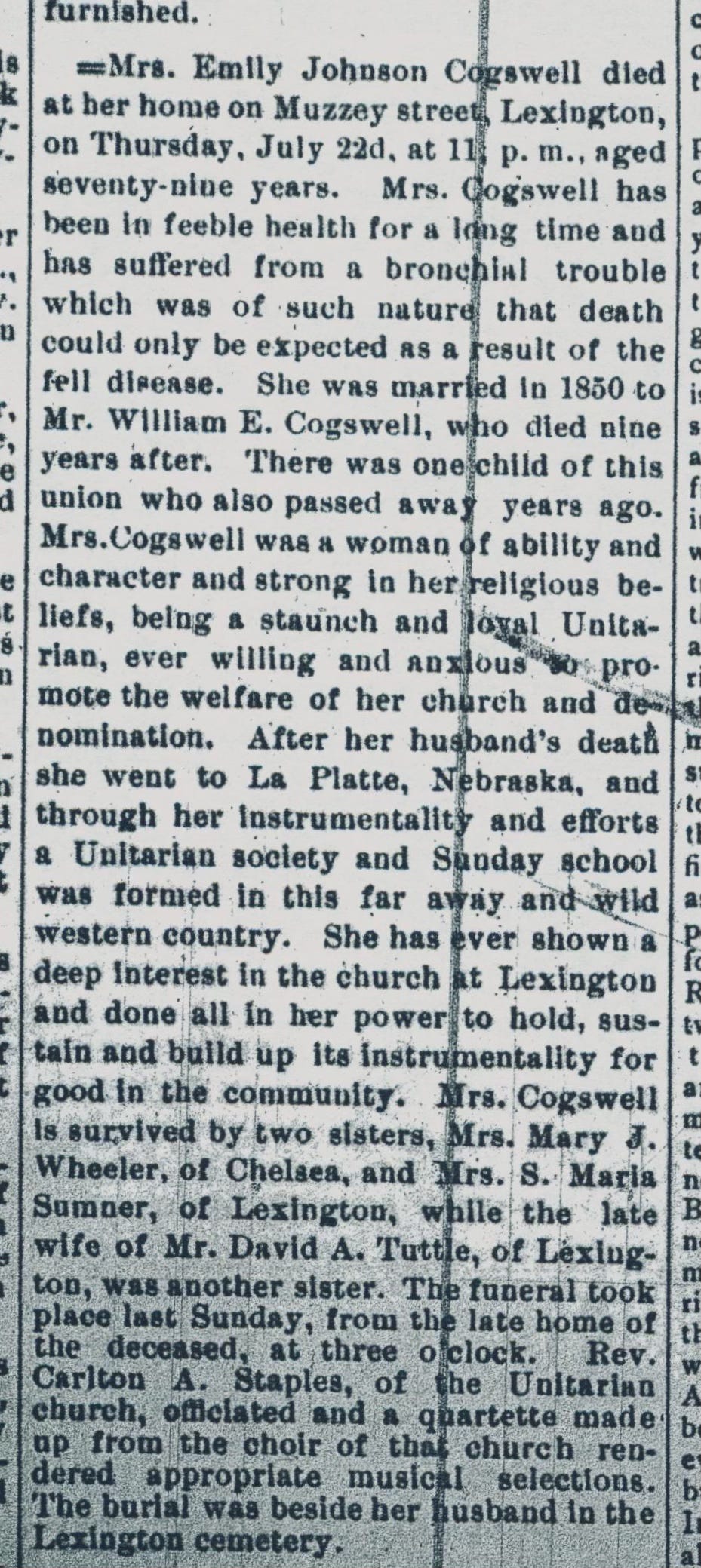
Emily Johnson was born in Lexington, Massachusetts in 1818, the third of four daughters. She graduated from Framingham Normal School in 1841 and taught there briefly. In 1850, at the rather advanced age of 32, she married William Cogswell; they had one child, William J. Cogswell, in 1853, who died in infancy. The 1855 Massachusetts census found the couple sharing a home with her mother and her younger sister Susan Johnson Tuttle and her family. Four years later, at the age of forty-one, she was widowed when William Cogswell died of tuberculosis. Within a few more years, her mother died as well. In 1866 she began teaching French and mathematics at Dio Lewis’s School for Young Ladies in Lexington. The school burned to the ground a year later.
Up to that point, Emily Johnson Cogswell’s life was rather unremarkable. She had a bit more education than most women like her, and also a bit more bad fortune. An ordinary ending to her story would find her living with one of her three married sisters, helping with the housekeeping and child care. But she didn’t. In 1868, Emily got on a train and headed west, literally to the end of the line, to the brand new state of Nebraska, to a railroad town at the confluence of the North and South Platte Rivers, midway horizontally and vertically between Omaha and Denver.
She made this journey a year before the transcontinental railroad was completed. North Platte had been the “end of the line” from the east since 1866, when conflicts with the local Pawnee and Sioux had stalled work on the tracks. The first commercial buildings were just being erected when Emily Cogswell stepped off the train and established a Unitarian fellowship in a log cabin near the station. This was one year before the incorporation of First Unitarian Church in Omaha, which has the distinction of being the oldest congregation in the state. In fact, Massachusetts teacher and minister Joseph Henry Allen also went to Nebraska in 1868, meeting with the group that was organizing the Omaha church. He wrote to a friend that he had planned “to go out a few hundred miles” but decided against it because “the expense is heavy and the way excessively monotonous and dreary, by all accounts.” But Emily, we now know, persisted.
Over the next thirty years, Emily Cogswell worked doggedly to establish and maintain what came to be called “the North Platte mission”. She was a regular attendee at Western Unitarian Conference meetings, and when she could not attend, she sent reports. She also returned home to Lexington at least four times in the 1870s and 1880s to raise funds and solicit donations of books and other goods for North Platte. She was able to attract ordained ministers to North Platte on occasion, but rarely for more than a Sunday service. The lone exception was Rev. Anna Norris, the longest-serving minister in North Platte. A member of the “Iowa Sisterhood”, Norris graduated from Meadville Theological School and served the North Platte fellowship on a circuit for three years, before moving on to Colorado and planting Foothills Unitarian Church in Fort Collins. In her book Prophetic Sisterhood, Cynthia Grant Tucker describes her as “a marginal figure”, but Norris and the Rev. Mary Leggett were quite active in the High Plains for many years. Enoch Powell wrote about her work in Unity, calling her “the brave little woman preacher”. She left more of a written record than Emily Cogswell, corresponding with Unity and also writing regular columns for two of the local North Platte newspapers.
For most of the thirty years she was in Nebraska, Emily Cogswell served as an unordained minister, giving sermons, teaching Sunday school, and conducting funeral services. She supported herself by teaching music and is listed in the 1870 census as a teacher. Besides the monies raised by her Lexington parties, the Fellowship was funded by rentals (theatrical and musical events, and even the entire 8th grade class, for one school year). There was also modest income from boarders staying in what was called in one report “the parsonage”. In her late seventies and in failing health, she returned to her home in Lexington and died there in 1897. The North Platte fellowship disbanded in the early twentieth century, the building was sold, and eventually was demolished.
In the summer of 2019 I spent some time at the Andover Harvard Theological Library looking for traces of Emily in the correspondence of Boston area ministers known to have sent parishioners or donations to her fundraising events. These included such luminaries of the movement as Minot Judson Savage, minister of the Church of the Unity, and Edward Augustus Horton, minister of Second Church in Boston. Edward Everett Hale’s correspondence included the ministers of the Lexington church, one of whom, Carleton Staples, led me back to the Western Unitarian Conference and helped me understand some of the conflicts between the New England-based church and the more progressive, humanist-leaning Unitarians in the west. I caught glimpses of Emily Cogswell in these letters and in the reports that appeared in Unity, the Western Conference’s publication. They mention her work, and occasionally even refer to her by name.
For all this information, I still have so many questions about Emily Cogswell and about the North Platte fellowship. Where did Emily get the idea to head to Nebraska, in the first place? Was she inspired, for example, by a visitor to Lexington who spoke about going west? How did she finance her journey? What messages did Cogswell, Norris and preachers bring to North Platte? Was her theology influenced by the Western Unitarian conference, and if so, how and when? How involved was the Lexington church in her efforts, beyond her occasional fundraising visits?
There is at least one more visit to Lexington to be arranged; I cling to the fond hope that one of Emily Cogswell’s sisters might have living descendants, the sort of people who would hang on to letters from a great-great aunt. I am also destined to return to North Platte to track down some of the other lay leaders who worked with Emily Cogswell and who kept the struggling fellowship going after her death.
The archives of the The Western Unitarian Conference seem to be a promising source; the conference secretary, John Effinger, preached in North Platte, and perhaps his correspondence will tell me more about that group and its activities.
Maybe someone reading these words has come across Mrs. E. J. Cogswell, too, or someone like her. It seems unlikely that she was unique. I would not be surprised if we learn that message of liberal faith was carried across the United States by many such uncredentialed evangelists.
And now she’s a poem:
Brave Emily: A True Story

Emily Cogswell (born 1818) having just turned fifty,
Stepped on a train and traveled west.

Leaving behind her (dead) infant son, her (dead) husband, and her (recently dead) mother.
Even the school where she taught French and mathematics to young ladies lay in ashes.

So Emily Cogswell hugged her sisters,
Stepped on a train and traveled west.

Sister Mary shook her head.
“Always so headstrong,” she whispered.

Sister Maria nodded, wiping away a tear.
“Even as a child, determined to have her way.”

Susan, the youngest, had opinions, too.
“She’ll be back within the year.”

Emily Cogswell stepped on a train and traveled west. And stayed.
Well I went down your article like a rabbit hole. No helpful information here but a fascinated reader! I would guess that the extent of her liberal faith in her home congregation influenced how liberal she was as a lay preacher. That and her own personal life events. Hope you find some of her voice in a letter somewhere! Good poem!